
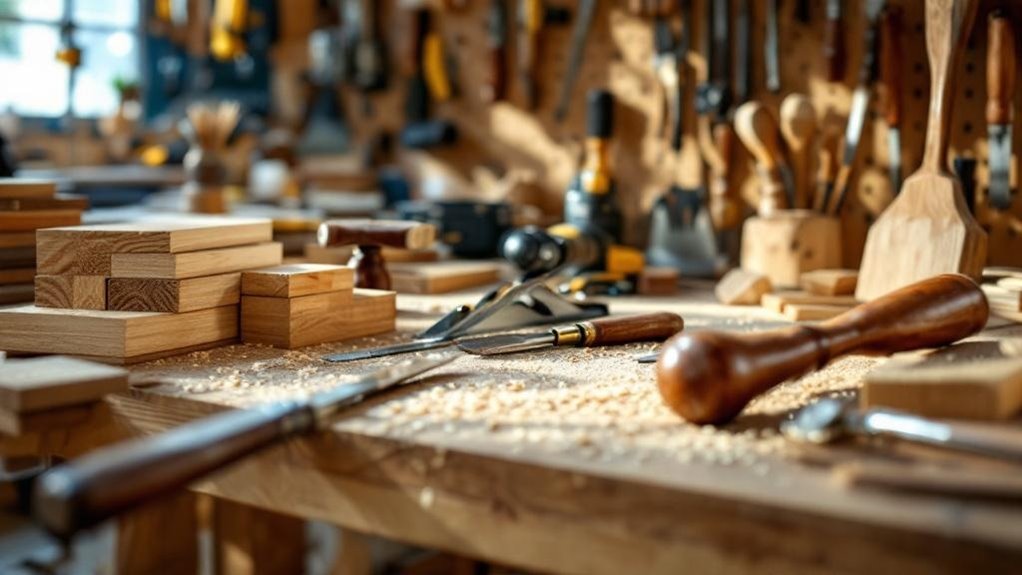
You’ll need a balanced toolkit combining hand and power tools to handle any woodworking project effectively. Start with essential hand tools like chisels, saws, and hammers for precision work, then add power tools—circular saws, table saws, and drills—for efficiency. Don’t overlook precision instruments like combination squares and measuring tapes for accuracy. Invest in a sturdy workbench with proper clamping systems, safety gear including glasses and dust masks, and establish routine maintenance habits. Understanding which tools serve specific projects will dramatically elevate your workshop’s capabilities.
Key Takeaways
- Hand tools like chisels, saws, and hammers provide foundational versatility for all woodworking projects.
- Power tools including circular saws, table saws, and drills dramatically increase efficiency and precision capabilities.
- Precision measuring instruments and squares ensure accurate cuts and joints throughout your woodworking projects.
- A properly organized workbench with appropriate height and clamping systems improves workflow and safety.
- Safety gear and regular tool maintenance protect your health while preserving tool longevity and performance.
Essential Hand Tools Every Woodworker Needs
You’ll find that five core hand tools form the foundation of any functional woodworking workshop. A crosscut saw cuts across the grain while a rip saw cuts along it, giving you versatility for different projects.
Chisels in ¼-inch, ½-inch, and 1-inch sizes handle detailed carving and shaping tasks. A claw hammer drives nails and removes them efficiently during assembly. You’ll need a combination square to guarantee straight lines and proper angles, which are vital for accuracy.
Finally, a wooden or rubber mallet safely drives chisels without damaging their edges. Together, these hand tools provide everything you need to tackle woodworking projects with confidence and precision.
Invest in quality versions of each tool for durability and performance.
Power Tools That Transform Your Workshop
While hand tools provide the foundation for woodworking, power tools dramatically accelerate your workflow and expand what you can accomplish.
A circular saw delivers precision for rip cuts and crosscuts through plywood and lumber, making it one of your most versatile power tools.
You’ll find a table saw indispensable for larger workpieces, providing the accuracy and power that define professional results.
A router transforms ordinary pieces into unique creations by crafting decorative edges and complex joints.
Don’t overlook a drill and impact driver combo—the impact driver’s superior torque outperforms standard drills when driving screws.
These power tools collectively reduce physical effort and project timelines while elevating your woodworking capabilities to new levels.
Corded or Cordless? Making the Right Choice
You’ll find that corded tools deliver superior power and sustained performance for heavy-duty woodworking tasks, while cordless models prioritize mobility and convenience for lighter projects.
Battery limitations and the expense of additional batteries and chargers can substantially impact your overall investment, making cost analysis essential before you commit to either option.
Your choice ultimately hinges on matching your tool selection to your specific woodworking demands, workspace constraints, and financial parameters.
Power And Performance Comparison
When you’re deciding between corded and cordless tools, you’re fundamentally choosing between raw power and mobility. Your decision hinges on three critical factors:
- Power output: Corded tools deliver consistent, higher wattage for demanding woodworking tasks without performance degradation.
- Battery limitations: Cordless tools restrict usage duration, necessitating multiple batteries for extended projects or continuous work.
- Application suitability: Precision work requiring steady, reliable power favors corded options, while cordless excels for mobile tasks.
Corded tools maintain unwavering performance throughout extended sessions, making them ideal for heavy-duty operations.
Cordless tools sacrifice some power for portability, though modern lithium-ion batteries have narrowed this gap considerably.
Evaluate your typical projects’ power demands and workspace constraints. If you’re tackling intricate joinery or extended production runs, corded dominates.
For site-to-site flexibility, cordless offers unmatched convenience despite battery considerations.
Cost And Battery Considerations
The financial equation between corded and cordless tools extends far beyond the initial purchase price.
You’ll discover that cordless tools demand substantial upfront investment, particularly when you factor in multiple batteries to maintain productivity during extended projects. These additional battery purchases greatly increase your total cost.
Corded tools present a more economical alternative for workshop-based operations, requiring only a single electrical outlet. However, you must weigh this savings against cordless tools’ superior mobility and convenience for job sites.
Battery life emerges as a critical cost consideration. You’ll need to evaluate whether cordless tools’ limited runtime justifies their premium pricing for your specific projects.
Consider your budget constraints alongside portability requirements when determining whether cordless or corded tools best serve your woodworking needs.
Precision Tools for Professional-Quality Results
To achieve the tight tolerances and flawless joinery that distinguish professional woodworking, you’ll need precision instruments that go beyond basic workshop equipment. These miter saws and specialized precision tools elevate your fine woodworking capabilities greatly.
- Measurement instruments: Calipers and marking gauges provide millimeter-level accuracy, ensuring your specifications meet exacting standards for every component.
- Stock preparation equipment: A jointer flattens and straightens lumber while thickness planers deliver uniform board dimensions, establishing the foundation for seamless assembly without gaps or inconsistencies.
- Detailing capabilities: Routers enable intricate joinery work and decorative edge work, transforming functional pieces into refined finished products.
These precision tools aren’t luxuries—they’re investments that transform your results from adequate to exceptional.
This enables you to execute demanding projects with confidence and accuracy.
Workbench Essentials: Height, Clamping, and Layout
Your precision tools are only as effective as the platform supporting them, and that platform is your workbench.
You’ll want to set your workbench height between 34 and 38 inches to maintain proper posture and reduce fatigue during extended work sessions.
Integrate a sturdy clamping system—vises or bench dogs—that securely holds workpieces during cutting and assembly. This prevents movement that compromises accuracy.
A sturdy clamping system with vises or bench dogs secures workpieces and prevents movement that compromises precision during cutting and assembly.
Your work surface should be flat and stable, constructed from hardwood or laminated plywood for precision and durability.
You’ll also benefit from organizing your workshop tools and materials into designated zones, keeping your workspace uncluttered and efficient.
Consider mobile workbenches with locking wheels; they adapt to your shop’s layout and enable quick reconfiguration when needed.
Storage Solutions That Speed Up Project Workflows
Since you’ve established a solid workbench foundation, it’s time to organize the tools and materials surrounding it—because an efficient storage system directly determines how quickly you’ll access what you need.
Implement these storage solutions in your workshop:
- Vertical storage systems like pegboards and wall-mounted racks maximize space while keeping tools visible and accessible.
- Custom cabinets or mobile carts house frequently used tools, allowing you to transport equipment efficiently across your workshop.
- Labeled drawer organizers and bins for fasteners eliminate wasted time searching for screws and nails during projects.
A rolling workbench with built-in storage combines assembly space with immediate tool access, further streamlining your workflow.
Strategic labeling accelerates component location, creating an organized environment that supports rapid project completion. These thoughtful storage solutions transform your workshop into a highly functional space.
Keep Your Tools Sharp and Ready
Three critical practices—sharpening, cleaning, and maintenance—distinguish a productive workshop from one plagued by frustration and safety risks.
You’ll cut wood more efficiently when your blades stay sharp, whether you’re using a hand saw or specialized bits. Dull tools demand excessive force, compromising both accuracy and safety.
Invest in appropriate sharpening equipment like whetstones or honing guides tailored to your blade types.
After each project, you should clean tools thoroughly to remove sawdust and moisture that accelerate rust. Lubricate moving parts with oil to minimize friction and extend tool longevity.
Proper storage—hanging hand tools on pegboards and securing power tools in protective cases—safeguards edges and guarantees readiness.
You’ll maintain sharpness over time through these deliberate practices, transforming your workshop into a reliable, efficient space where quality work happens consistently.
Woodworking Tools for Specific Projects
You’ll need a table saw and miter saw to build quality furniture, as these tools deliver the precise cuts and angles required for joints that fit snugly and hold strong.
For decorative trimwork, you’ll rely on a router to create finished edges and intricate joinery like dovetails, which elevate both the visual appeal and structural integrity of your pieces.
Pairing these specialized tools with a drill and impact driver set streamlines your assembly process and guarantees professional results.
Furniture Building Essentials
When you’re constructing furniture, you’ll need tools that deliver both precision and versatility. Your workshop should prioritize equipment that guarantees accuracy and durability throughout assembly.
Essential furniture-building tools include:
- Miter saw – delivers precise angle cuts for corners and joined pieces with exceptional accuracy
- Circular saw – handles rip cuts and crosscuts efficiently through plywood and lumber sheets
- Router – adds decorative edges and grooves, elevating aesthetic appeal
Additionally, you’ll benefit from a pocket hole jig, which creates hidden, reinforced joints that minimize visible fasteners while maximizing durability.
Chisels prove invaluable for detailed work, enabling you to craft clean joints and refine edges for a polished, professional finish.
These tools collectively provide the precision, strength, and craftsmanship required for quality furniture construction.
Decorative Trimwork Precision
Decorative trimwork demands a specialized toolkit that balances precision with aesthetic refinement.
You’ll find a miter saw indispensable for making precise angle cuts that create clean, accurate joints at trim corners. A router equipped with specific bits lets you add decorative edges and profiles to door casings, window frames, and baseboards, elevating their visual appeal.
Clamps hold pieces firmly in place during assembly, ensuring tight joints and eliminating gaps that compromise installations. You’ll also need a measuring tape and square to maintain accurate measurements and angles throughout your project.
Finally, incorporate a finish sander to smooth trim surfaces, preparing them for superior paint or stain application that showcases your craftsmanship.
Essential Safety Gear for Your Workshop
Because woodworking exposes you to numerous hazards—from airborne particles to heavy machinery—proper safety gear isn’t optional; it’s foundational to protecting your health and preventing serious injury.
Woodworking hazards demand proper safety gear—it’s not optional but essential for protecting your health and preventing serious injury.
You’ll need three critical protective items:
- Safety glasses reduce eye injury risk by up to 90%, shielding against dust, debris, and flying particles during all tasks.
- Hearing protection prevents permanent damage from prolonged machinery exposure, as wood shop noise regularly exceeds 85 decibels.
- A dust mask or respirator filters harmful airborne particles, protecting your lungs from chronic bronchitis and other respiratory diseases.
Additionally, you’ll want steel-toed boots to guard against dropped objects and provide slip-resistant traction.
You should also consider durable work gloves protecting your hands from splinters, cuts, and abrasions while improving your grip on tools and materials.
Budget-Friendly Strategies to Build Your Toolkit
How do you build a quality woodworking toolkit without breaking the bank? Start with essential hand tools like chisels, hand saws, and claw hammers—affordable options that deliver versatility every time. Used tools represent a smart investment; check their condition carefully before purchasing.
Gradually invest in core pieces like a circular saw and drill/impact driver, great tools that handle multiple tasks efficiently.
Strategic shopping maximizes your budget. Time your purchases around hardware store sales and discount events, stocking supplies like sandpaper and fasteners when prices drop.
Join woodworking clubs and online communities where members regularly swap or sell tools at reduced rates. This approach builds a capable workshop systematically while maintaining financial discipline. You’ll acquire quality equipment progressively without excessive upfront costs.
First Projects That Justify Your Investment
Now that you’ve assembled your foundational toolkit, it’s time to put those tools to work on projects that’ll prove their worth.
Strategic project selection demonstrates tool necessity while building confidence:
- Simple furniture pieces like bedside tables utilize your table saw and drill press, establishing why quality cutting and assembly tools are still essential for professional results.
- Custom workbenches require miter saws and clamps, justifying investments in specialized equipment that handles precision tasks efficiently.
- Storage solutions such as tool chests showcase routers and pocket hole jigs, revealing how versatile equipment maximizes workshop organization.
These introductory projects validate your tool investments by demanding multiple implements throughout construction.
Introductory projects validate tool investments by demanding multiple implements throughout construction.
You’ll recognize why each tool’s capability matters when executing accurate cuts, secure joinery, and refined finishes on functional pieces that serve daily purposes.
Frequently Asked Questions
How Often Should I Replace Worn-Out Tools in My Workshop?
You’ll replace worn-out tools when they’re damaged, dull, or unsafe to use. Don’t wait for complete failure. Sharp chisels, saw blades, and sanders typically need replacing annually with regular use. Inspect tools monthly for deterioration.
What’s the Best Way to Organize Tools by Frequency of Use?
You’ve got to arrange your tools like a well-worn path through the forest—your most-used chisels and saws at arm’s reach, secondary tools nearby, rarely-used specialty equipment stored deeper in your workshop’s recesses.
Are Expensive Brand-Name Tools Worth the Investment Over Generic Alternatives?
You’ll find brand-name tools offer superior durability, precision, and ergonomics that justify their cost for serious woodworkers. You’ll experience fewer replacements and better results, making them worthwhile investments over cheaper alternatives.
How Can I Prevent Rust and Deterioration of My Tool Collection?
An ounce of prevention’s worth a pound of cure. You’ll prevent rust by storing tools in dry environments, applying protective oil coats regularly, using silica gel packets, and maintaining consistent humidity levels below fifty percent.
Which Tools Are Most Important to Purchase First as a Beginner?
You’ll want to start with a quality handsaw, hammer, and screwdriver set. Add a tape measure, level, and clamps next. These fundamentals give you versatility for most beginner woodworking projects you’ll encounter.
Conclusion
You’ve got the roadmap to build your workshop, and now it’s time to stop spinning your wheels and start swinging hammers. Begin with essential hand tools, add power equipment strategically, and invest in precision instruments that matter for your projects. Your workbench becomes your command center—treat it seriously. Safety gear isn’t optional; it’s non-negotiable. You’ll discover that quality tools aren’t expenses; they’re investments that elevate every project you create and make your craftsmanship genuinely exceptional.