
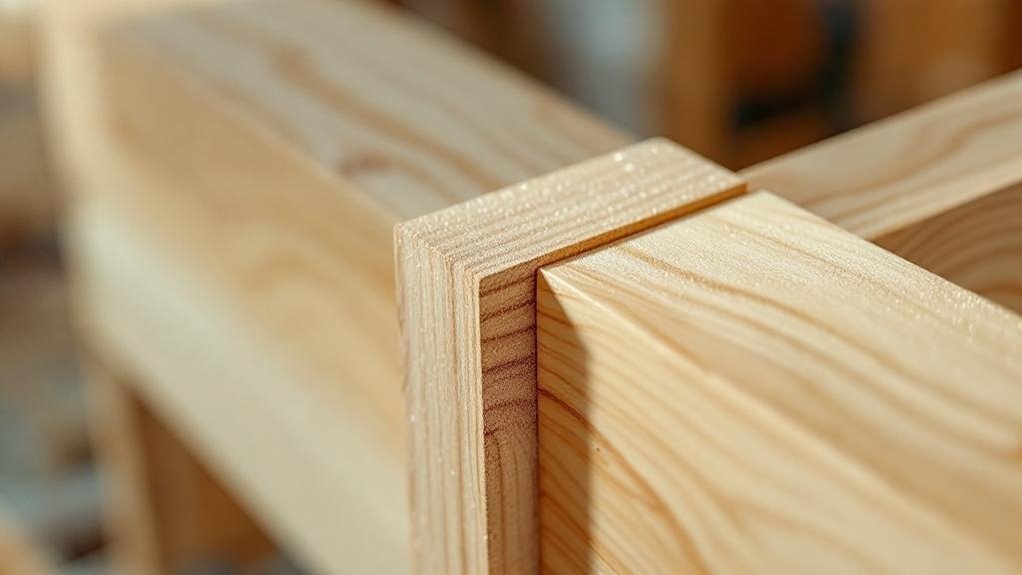
You’re bonding wood at the molecular level when you apply glue, creating joints that often exceed the wood’s own strength—something screws and nails can’t achieve. Wood glue establishes adhesion through intimate surface contact while building internal cohesion within the adhesive layer itself. It distributes stress evenly across the entire joint, preventing material splitting and joint failure. When you prepare surfaces properly and control moisture below 10%, you’ll develop bonds that accommodate natural wood movement and outlast mechanical fasteners remarkably, though there’s considerably more to mastering this technique.
Key Takeaways
- Wood glue creates continuous bonds across joint surfaces, distributing stress evenly and preventing material splitting compared to mechanical fasteners.
- Proper surface preparation at 120–220 grit and clean, dry surfaces maximize adhesive penetration into wood fibers for stronger, longer-lasting joints.
- Correct clamping pressure of 100-150 psi during curing ensures consistent, durable adhesion between wood surfaces.
- Different glue types—PVA, epoxy, polyurethane—address specific applications and wood species, allowing tailored solutions for diverse woodworking projects.
- Water-based adhesives like PVA offer easy cleanup, quick repositioning windows, and cost savings while eliminating chemical odors and toxicity concerns.
How Wood Glue Outperforms Screws and Nails
When you’re joining wood pieces, you’ll find that wood glue creates a continuous bond across the entire surface area of the joint, delivering superior strength compared to screws and nails, which anchor only at discrete points.
Wood glues distribute stress evenly throughout the connection, preventing the splitting and weakening that mechanical fasteners cause through concentrated pressure. Your joints will actually exceed the wood’s own strength, resulting in a durable bond wood professionals rely on.
Additionally, wood glues accommodate natural wood movement, absorbing shifts that’d otherwise trigger joint failure with rigid fasteners. When you bond wood using adhesives across different species, you’ll achieve robust connections that screws and nails simply can’t match.
This flexibility and all-encompassing coverage make wood glues the superior choice for strong bond performance.
Understanding Adhesion and Cohesion in Wood Glue
You’ll find that adhesion success depends on your ability to establish intimate contact between the glue and wood surfaces, requiring compatible materials that allow the adhesive to penetrate effectively.
Your cohesive networks—the internal molecular structure within the glue itself—must then reinforce this bond by creating strength that often exceeds the wood’s own tensile capacity.
Understanding how these two mechanisms interact will guide your selection of the appropriate adhesive for each specific woodworking application.
Intimate Contact and Compatibility
Since wood glue’s effectiveness hinges on intimate contact between adhesive and wood surfaces, understanding the interplay of adhesion and cohesion becomes essential to achieving strong joints. You must ascertain compatibility between your glue and wood materials to maximize molecular attraction.
Clean surfaces are non-negotiable—they eliminate contaminants and moisture that’d compromise adhesion. When you achieve close contact between the adhesive and mating surfaces, you facilitate the chemical bonding process that creates durable joints.
The glue’s molecular structure must align with wood’s porous nature, allowing penetration into the grain. You’ll find that properly prepared surfaces—free from dust, oils, and excess moisture—enable the adhesive to establish strong molecular connections.
This foundation directly impacts how effectively cohesion develops within the glue layer itself.
Cohesion Building Strong Networks
While adhesion establishes the initial contact between glue and wood, cohesion—the internal strength within the glue itself—is what ultimately determines your joint’s durability.
Cohesion builds a strong internal network that binds the glue molecules together, creating the structural integrity necessary for reliable woodworking joints. This molecular bonding within the adhesive itself is essential because it prevents the glue layer from failing under stress.
During the curing process, the glue changes from liquid to solid, and its molecules interlock to form an increasingly strong matrix. This cohesive strength often exceeds the wood’s own strength, meaning your wood typically fails before the glue bond does.
Understanding cohesion helps you recognize that your joint’s longevity depends on the glue’s internal integrity, not just surface contact.
Why Woodworkers Choose PVA Over Alternatives
You’ll find that PVA glue’s straightforward application process—requiring no mixing, specialized equipment, or complex surface preparation—streamlines your workflow across diverse joinery tasks.
When you compare PVA’s cost-per-project to premium alternatives like epoxy or polyurethane, you’re looking at significant savings without sacrificing joint strength or reliability.
This combination of minimal application complexity and superior cost-effectiveness makes PVA the pragmatic choice for both professional and amateur woodworkers managing project budgets and timelines.
Ease Of Application
When you’re working against tight deadlines, PVA glue‘s pre-mixed formula eliminates preparation steps that other adhesives demand, letting you apply it straight from the container with no mixing ratios to calculate or components to blend. This ease of application accelerates your workflow considerably.
PVA glue streamlines your woodworking process through:
- Immediate usability – no complex preparation required for any skill level
- Optimal viscosity – penetrates wood fibers effectively for strong joints without additional techniques
- Quick repositioning window – fifteen-minute adjustment period accommodates precision placement
- Easy to clean – water-soluble properties eliminate harsh solvents and tool maintenance hassles
You’ll appreciate how PVA glue’s straightforward application reduces frustration while delivering consistent results.
The absence of complicated procedures means you focus on craftsmanship rather than adhesive management, ultimately producing superior woodworking projects efficiently.
Superior Cost-Effectiveness
Because PVA glue delivers substantial financial advantages without compromising performance, it’s become the preferred adhesive for woodworkers managing both tight budgets and demanding timelines.
You’ll find PVA glue considerably cheaper than epoxy or polyurethane alternatives, reducing material expenses across projects. Its widespread availability eliminates high shipping costs and wait times, further enhancing affordability. You don’t need special mixing or preparation—this translates directly into labor cost savings.
The quick drying time accelerates your workflow, enabling you to complete multiple tasks efficiently within budget constraints. Most importantly, you’ll gain exceptional long-term value because PVA bonds typically fail only after wood itself fails, proving more reliable than costlier options.
This combination of affordability, accessibility, and durability makes PVA glue the practical choice for maximizing your project’s overall cost-effectiveness.
Wood Moisture: The Make-or-Break Factor
Moisture content stands as one of the most critical variables in wood glue performance, and it’s often underestimated by woodworkers. You’ll find that controlling wood moisture content directly determines your glue adhesion success.
Key moisture management considerations:
- Moisture levels exceeding 10% considerably hinder effective bonding and create weak joint structures.
- Excess moisture generates thin glue lines that compromise long-term structural integrity.
- Cross-grain joints demand elastic glues to accommodate wood movement and moisture fluctuations.
- Exotic woods with high resin content require meticulous moisture control for successful application.
You must maintain similar moisture content between wood and adhesive for ideal results. Proper drying procedures aren’t optional—they’re crucial.
When you neglect moisture control, you’re fundamentally guaranteeing joint failure. Your projects’ durability depends entirely on respecting this fundamental principle of woodworking adhesion.
Surface Prep That Actually Strengthens Bonds
While moisture control sets the foundation for successful bonding, surface preparation is where you’ll truly determine whether your joints achieve maximum strength or fail prematurely.
Proper surface preparation demands that you sand joint surfaces to 120–220 grit, removing debris and raising wood grain to expand your surface area. You’ll then eliminate oils and finishes using denatured alcohol or acetone, ensuring the glue contacts wood substrate directly.
Sand joints to 120–220 grit and remove oils with denatured alcohol for superior glue contact and adhesive penetration.
Clean and dry surfaces allow superior adhesive penetration into wood fibers, dramatically strengthening your bond.
When applying glue evenly in thin layers across 100% of bonding surfaces, you’ll maximize contact and promote robust adhesion. This meticulous approach prevents joint failure and delivers the durable connections your woodworking projects demand.
Matching Glue Type to Your Wood Species
You’ll find that different wood species demand specific glue formulations based on their density, resin content, and moisture characteristics.
Dense hardwoods and exotic species with high resin content require glues engineered for superior penetration and adhesion—such as thin-viscosity PVA or specialized epoxy formulations—while softer woods may accommodate standard wood glues with extended open times.
Your wood’s grain direction and joint configuration further determine which adhesive will deliver maximum strength, since long-grain joints typically perform well with conventional glues, whereas cross-grain assemblies benefit from elastic or flexible adhesive systems.
Wood Species Characteristics
Because different wood species possess distinct chemical and physical properties, selecting the appropriate adhesive becomes essential for achieving reliable joints.
You’ll find that wood species characteristics directly influence which types of wood glue work best for your projects.
- Moisture levels below 10% guarantee PVA glue forms strong bonds in most applications
- Hardwoods like oak and maple require water-resistant formulations such as Titebond II
- Softwoods’ resin content demands adhesives that penetrate effectively and overcome natural oils
- High-density woods benefit from polyurethane glues that expand and fill grain gaps
- PVA glue excels at wood-to-wood joints like edge gluing and dowels with its strong, reliable bond.
- Epoxy fills gaps in dissimilar materials while delivering waterproof, exceptional strength.
- Polyurethane glue expands during curing, effectively sealing uneven surfaces and irregular joints.
- Aliphatic resin glues (Titebond II and III) resist moisture, performing reliably indoors and outdoors.
- 100-150 psi is ideal for strong enough adhesion without fiber damage
- Uneven pressure creates gaps that prevent glue penetration
- Insufficient clamping leads to weak joints prone to separation
- Consistent pressure during the manufacturer’s curing time guarantees durable joints
- Moisture content: Keep wood below 10% for peak adhesion; excess moisture creates weak glue lines.
- Proper application: Apply consistent pressure and avoid dirty or uneven surfaces.
- Glue types: Match your adhesive to conditions—PVA fails on end grain, while epoxy handles gaps effectively.
- Environmental control: Monitor temperature and humidity during curing.
- Solid glues eliminate spreading requirements, enhancing efficiency without cleanup hassles
- Liquid glues provide superior fiber penetration for durable strong bonds
- Both formats now incorporate instant bonding and environmental resistance
- Future innovations will balance ease of use with versatile material compatibility
You’re responsible for matching glue works to your specific wood species.
Exotic woods with high resin content may require epoxy’s superior adhesion properties.
Glue Compatibility Factors
Successful wood bonding depends on aligning your adhesive selection with the specific characteristics of your chosen wood species.
You’ll achieve maximum glue compatibility when you match moisture content levels—ideally keeping both wood and adhesive below 10% for effective adhesion.
Exotic woods with high resin content demand specialized approaches or polyurethane glue, whereas traditional species bond readily with PVA adhesives.
You can assess wood surfaces through wettability testing; poorly absorbing woods require primers or aggressive adhesives.
Understanding your wood’s pH is critical, since acidic or alkaline species challenge water-based glues.
Cross-grain joints necessitate flexible adhesives accommodating wood movement, while long-grain applications tolerate standard PVA or aliphatic resin glues.
You’ll guarantee superior results by evaluating these compatibility factors before committing to your project.
Which Glue Works Best for Different Joints?
What makes one adhesive superior to another when bonding wood? The answer lies in matching your glue to the joint type and environmental demands you’re facing.
You’ll also want to contemplate hide glue for fine woodworking and restorations, as its reversibility allows joint disassembly without damage.
Its extended open time gives you flexibility for precise alignment. Selecting the right adhesive fundamentally determines your project’s longevity and structural integrity.
Curing Time and Joint Durability: What You Need to Know
How quickly your glue sets and how long it takes to develop full strength are two entirely different timelines that’ll dramatically impact your project’s success. PVA glues typically achieve initial bond strength within 15 minutes, yet full curing requires up to 24 hours. Your joint durability depends critically on moisture content—you’ll want wood dried below 10% for ideal adhesion and maximum longevity.
Different glue types offer distinct advantages. Polyurethane formulations provide superior waterproof bonds for outdoor applications, substantially enhancing project durability.
Regardless of which adhesive you choose, proper application techniques prove essential. You must apply even glue layers and clamp pieces firmly to create joints that withstand stress.
Research confirms that in well-prepared joints, wood typically fails before the glue line, demonstrating adhesive effectiveness.
Why Clamping Pressure Matters More Than You Think
Because wood surfaces aren’t perfectly flat at the microscopic level, you’ll need adequate clamping pressure to force intimate contact between the wood and adhesive—this direct contact is what actually creates the bond.
Without proper clamping pressure, you’re compromising your glue line’s integrity.
Here’s what you should know:
The intimate contact you achieve through proper clamping directly determines your joint’s strength.
When you maintain recommended pressure throughout curing, the adhesive sets completely, creating bonds that withstand stress.
Inadequate clamping pressure is one of the most common causes of joint failure in woodworking projects.
Application Mistakes That Sabotage Your Bonds
Even with perfect clamping pressure, you’ll sabotage your bonds if you aren’t meticulous during application.
Application mistakes undermine adhesion before you’ve even started clamping pieces together. An insufficient amount of glue creates thin glue lines that fail to fill gaps adequately, compromising joint strength. Conversely, overworking the glue introduces air bubbles that weaken the adhesive matrix.
You must apply glue to clean, dry surfaces exclusively—dirt and moisture inhibit penetration and bond formation. Additionally, maintaining consistent moisture content in both wood and glue prevents post-curing separation and adhesion failure.
Avoid repositioning excessively once you’ve applied adhesive. Precision during application determines whether your bonds succeed or fail, regardless of downstream clamping technique.
When Your Glue Fails: and How to Avoid It
Glue joint failure rarely announces itself with drama—instead, it creeps into your work through a cascade of compounding mistakes that you’ve made during application, surface preparation, or wood conditioning.
You’ll prevent catastrophic failures by addressing these critical factors:
Understanding how moisture content affects your joint strength, selecting appropriate glue types for specific scenarios, and executing proper application techniques guarantee reliable bonds.
Your attention to these details separates lasting craftsmanship from premature failure.
Health and Environmental Benefits of Water-Based Wood Glue
As you’ve built your woodworking skills, you’ve likely noticed the chemical odor that lingers in your shop during traditional glue application—but water-based wood glues like PVA eliminate this concern entirely.
These non-toxic formulations contain no harmful solvents, safeguarding your indoor air quality during application and curing phases.
You’ll appreciate the eco-friendly cleanup process: water rinses away dried adhesive, eliminating your need for harsh chemical solvents.
Water-based wood glues feature minimal additives, substantially reducing their environmental impact compared to solvent-based alternatives.
The water-based formulation absorbs efficiently into wood grain, creating durable bonds while preserving material integrity.
Solid vs. Liquid Glues: The Future of Woodworking Adhesives
While liquid adhesives like PVA and epoxy have dominated woodworking for decades, solid glue technologies are emerging as a compelling alternative that could fundamentally reshape your jointing workflow.
Solid glues activate through heat or pressure, delivering faster applications with minimal mess. Conversely, liquid glues penetrate wood fibers to create strong bonds that frequently outlast mechanical fasteners.
Here’s what distinguishes these adhesive technology approaches:
Your choice depends on project demands. Solid glues prioritize speed and convenience, while liquid glues excel in penetration and longevity across diverse applications.
Frequently Asked Questions
Why Does Wood Glue Work so Well?
You’ll find wood glue works exceptionally well because it penetrates wood fibers deeply, creating both adhesive and cohesive bonds. When you clamp properly prepared joints, the wood typically fails before the glue does.
Why Is Wood Glue Good for Woodworking Projects?
You’ll benefit from wood glue’s superior strength that exceeds wood fiber capacity, eliminates fastener needs, reduces waste, and penetrates grain structures to create durable joints across diverse joinery applications.
Which Is Stronger, Gorilla Glue or Titebond?
You’ll find Titebond stronger for wood-to-wood joints because it creates superior shear strength and typically causes wood failure rather than glue-line failure. Gorilla Glue excels at gap-filling but isn’t ideal for woodworking applications.
Do I Really Have to Wait 24 Hours for Wood Glue to Dry?
You’ll achieve maximum strength waiting the full 24 hours, though you can handle pieces after 15 minutes. Temperature and humidity greatly affect curing; warmer, drier conditions accelerate drying, while cooler environments extend it considerably.
Conclusion
You’ll find that wood glue creates bonds stronger than the wood itself—studies show PVA adhesives achieve up to 3,500 PSI tensile strength. When you’re combining proper surface preparation, ideal moisture content, and correct application techniques, you’re creating a molecular bond that outperforms mechanical fasteners. You’re not just assembling; you’re engineering durability. Understanding these adhesion principles guarantees your projects withstand decades of structural stress.